 Spacebriefer
Space Debris: Why Orbital Fragments Have Become a Security Problem
In November 2021, the crew of the International Space Station was told to take shelter in their docked spacecraft. Russia had just destroyed one of its own satellites with a missile, and the resulting debris cloud was crossing the station’s orbit (NASA, 2021). The crew came through unharmed. Still, the episode captures what makes space debris so hard to deal with: one state’s decision put people and infrastructure belonging to many others at risk.
Space debris is often treated as a technical problem. In fact, it is just as much an operational, economic and security issue. It threatens individual missions, entire orbital regions and the growing number of actors who depend on them. If current behaviour continues, ESA warns that certain orbits could become unusable over time (ESA, 2023, 2025a).
Yet the debate is not only about risk. Research, engineering and policy have moved forward considerably. Approaches now range from better prevention and tracking to active debris removal (ADR), in which spacecraft capture defunct objects and bring them down. Debris is increasingly seen not as an unavoidable side effect of spaceflight, but as a risk that can be managed (ESA, 2023, 2025a).
Physical and Operational Risks
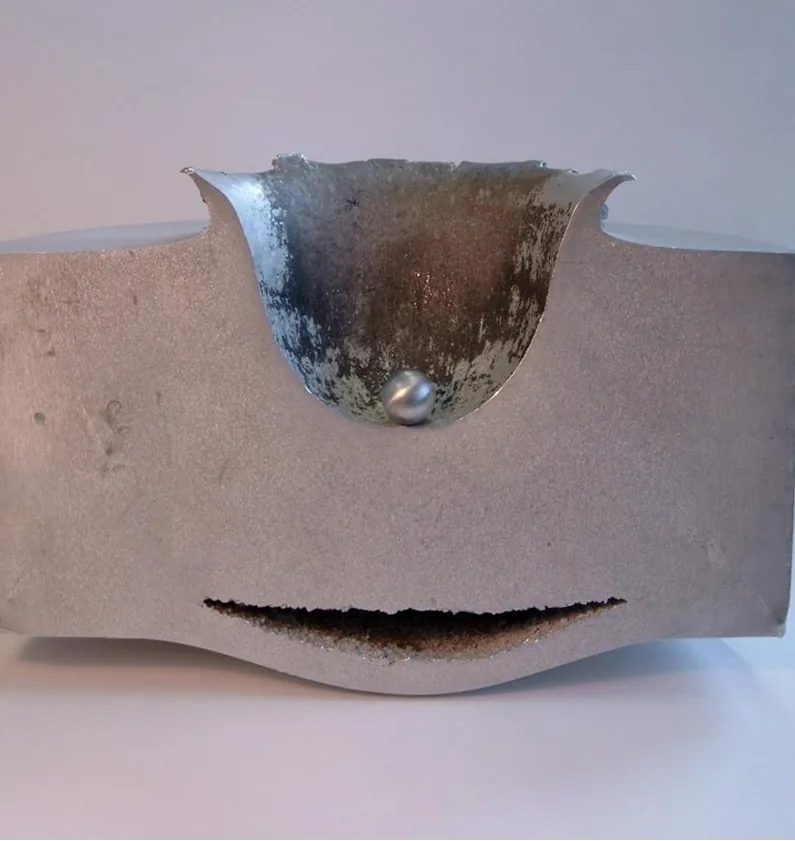
The most immediate danger is collision. In low Earth orbit (LEO), objects move at several kilometres per second. At these speeds, even very small fragments carry enough energy to damage critical systems or destroy a spacecraft entirely. ESA considers any object larger than one centimetre capable of catastrophic damage (ESA, 2025a).
The long-term danger has a name: the Kessler syndrome. In 1978, Donald Kessler and Burton Cour-Palais described a possible chain reaction in which collisions create fragments, these fragments cause further collisions, and the debris population grows faster than the atmosphere can remove it (Kessler & Cour-Palais, 1978). For a long time this was treated as a model scenario. ESA now speaks of a scientific consensus that the number of debris objects would keep growing even if no new satellites were launched, because fragmentation adds debris faster than it naturally re-enters (ESA, 2025a).
The problem is made worse by what cannot be seen. Space surveillance networks track about 40,000 objects. Yet ESA estimates that more than 1.2 million fragments larger than one centimetre are in orbit (ESA, 2025a). Most of the objects that could destroy a satellite are therefore invisible to operators, who cannot steer around hazards they do not know are there.
Strategic and Security-Related Risks
Space debris is also a security issue, because part of it is the product of military activity. Tests of kinetic anti-satellite (ASAT) weapons create debris clouds that spread far beyond the targeted orbit (NASA, 2021; Höyhtyä & Uusipaavalniemi, 2023). The 2021 Russian test is the clearest recent example. Debris created by one actor endangered human spaceflight and the satellites of states that had nothing to do with the test. It was not the first of its kind: in 2007, the deliberate destruction of China’s FengYun-1C weather satellite doubled the amount of debris at an altitude of about 800 km and increased the total debris population at the time by around 30 per cent (ESA, 2020).
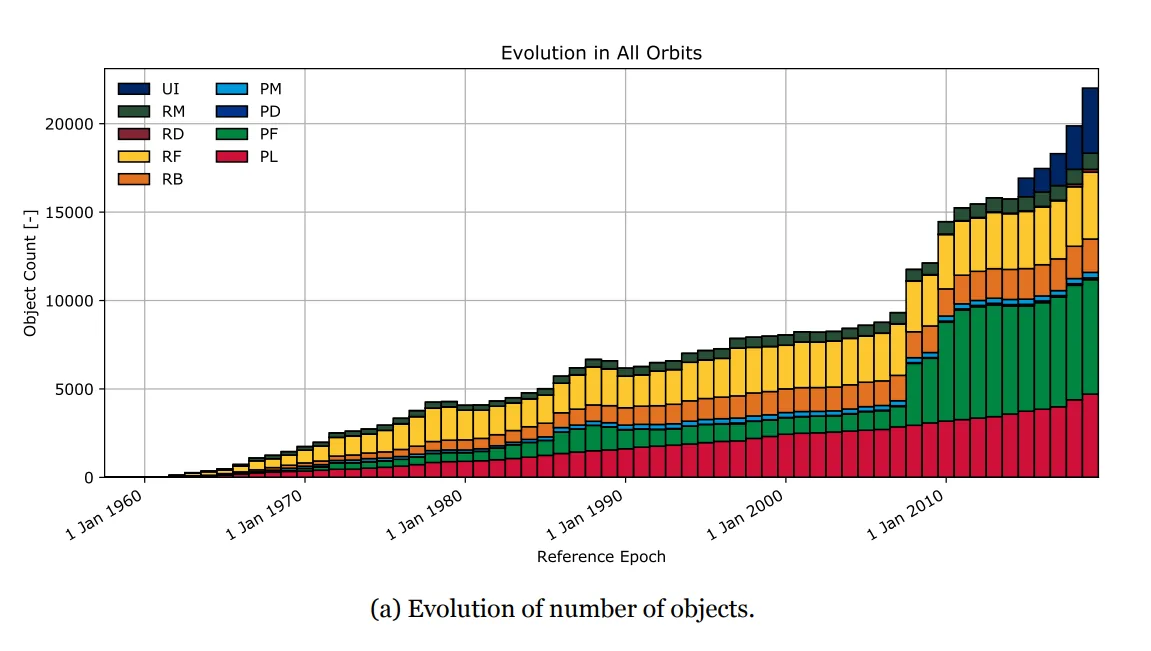
In a crowded and increasingly contested orbital environment, a collision with an untracked fragment could be mistaken for a deliberate attack, especially during a political crisis. Debris has no intention, but uncertainty about what caused an incident can still feed escalation. This risk is heightened by the fact that the current framework for governing space is widely seen as inadequate (Höyhtyä & Uusipaavalniemi, 2023).
Above all, kinetic action in space never stays limited to its target. It alters a shared environment on which communications, navigation, weather forecasting, disaster response and military coordination all depend (ESA, 2025a). The actions of a few can thus impose security costs on many.
Economic and Regulatory Challenges
Usable orbits are a finite resource, a point ESA puts at the top of its report in 2025 (ESA, 2025a). As debris accumulates, operating satellites becomes more demanding. In busy orbits, the number of collision warnings that require action rises every year (ESA, 2025a). Each avoidance manoeuvre costs fuel, can shorten a satellite’s lifetime and may interrupt its service (SciTechDaily, 2025).
These burdens add up over the whole life of a mission. According to the first OECD report on the economics of space debris, as summarised by ESA, protection starts with design measures and continues with surveillance and tracking, manoeuvres that move satellites out of harm’s way and, in the worst case, replacing a mission altogether. For satellites in geostationary orbit, such measures already account for an estimated 5–10 per cent of total mission costs, which can mean hundreds of millions of dollars. In low Earth orbit, the relative costs could be even higher (ESA, 2020).
Internet, weather and communication services could be lost, astronauts on the International Space Station would face greater risks, Earth science and climate research would be interrupted, other orbits would become more crowded and investment in the sector would slow. Rural areas with little ground infrastructure, which rely most heavily on satellites, would be hit hardest (ESA, 2020).
Cleaning up remains rare, and the reason can be read as a classic commons problem: everyone benefits from a cleaner orbit, but the costs of prevention, tracking and removal fall on individual operators and states. The same logic weakens prevention. Mitigation guidelines have existed for years: avoid deliberately creating debris, including through anti-satellite tests, minimise the risk of explosions, bring satellites in low Earth orbit down within 25 years and move geostationary satellites to a higher “graveyard orbit” at the end of their lives. Yet ESA reported in 2020 that while most operators in geostationary orbit followed these rules, fewer than 60 per cent of those in low Earth orbit did, and only 20 per cent above 650 km. As the OECD puts it, “comprehensive national and international mitigation measures exist, but compliance is insufficient to stabilise the orbital environment” (ESA, 2020).
The law adds another obstacle. Under the Outer Space Treaty and the Registration Convention, a space object remains under the jurisdiction and control of the state that registered it, even after it has stopped working (United Nations Office for Outer Space Affairs [UNOOSA], 1967, 1975). Removing someone else’s debris therefore generally requires that state’s consent. Technology raises a further problem. A spacecraft able to approach, capture and deorbit debris could, in principle, do the same to a working satellite. This dual-use potential can undermine trust and complicate international cooperation.
Positive Developments and Practical Examples
Despite these obstacles, debris removal is moving from theory to practice. Two missions stand out.
ClearSpace-1 is ESA’s planned demonstration of active debris removal. It was originally meant to capture Vespa, a payload adapter of about 100 kg left in orbit after the second flight of ESA’s Vega launcher in 2013 (ESA, 2020). After additional objects were detected near that target in 2023, ESA changed course: the mission will now remove ESA’s own defunct PROBA-1 satellite, with launch planned for 2029 (ESA, 2025b). The change of plan shows how much uncertainty such missions still involve.
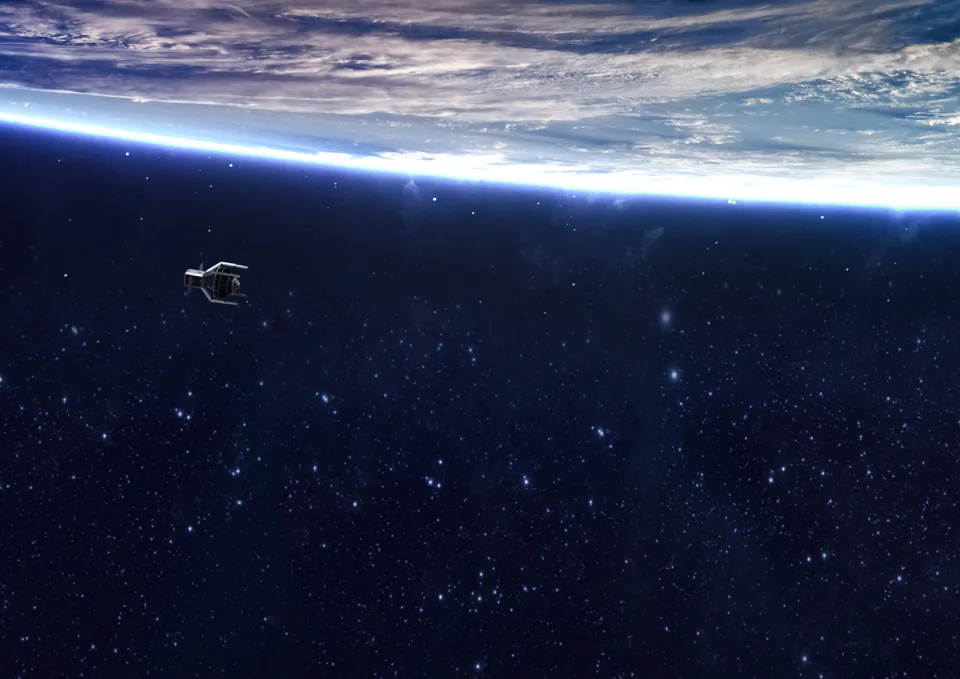
Astroscale’s ELSA-d tested in orbit how a servicer spacecraft can approach a target and capture it magnetically. It was not yet a full removal service, but it showed that key capabilities for future commercial missions work (Astroscale, 2021).
Researchers are also exploring contactless methods, such as using lasers to nudge small fragments so that they re-enter the atmosphere earlier. Whether such ideas will ever work at scale depends on their technical maturity, safety, cost and international rules. Operations are changing as well. Every day, teams at ESA’s mission control in Darmstadt assess the likelihood of collisions in orbit and advise operators on how to keep their missions safe. As more satellites are launched, these largely manual methods will no longer be enough. ESA is therefore developing automated collision avoidance: software that assesses the risk of a collision, supports the decision on whether a manoeuvre is needed and may one day send the commands to the satellite itself (ESA, 2020).
Policy is moving too. Under its Zero Debris approach, ESA aims to significantly limit the debris produced by its missions by 2030. For its own missions, it has cut the permitted disposal period in LEO from 25 to a maximum of five years (ESA, 2023). These steps do not remove the debris already in orbit, but they show a growing recognition that prevention and clean-up must go hand in hand.
Conclusion
Space debris is more than an environmental problem in orbit. It threatens operational safety, economic activity and strategic stability, and because modern societies depend so heavily on satellites, these risks reach far beyond the space sector. At the same time, stricter standards, better tracking and the first removal missions show that the problem is now being tackled systematically. According to ESA, though, the greatest effect would come from something less spectacular: consistent compliance with the debris mitigation rules that already exist (ESA, 2020). If technical progress is matched by international cooperation, many of the worst risks can be reduced. Keeping Earth orbit usable in the long run, however, will require both: preventing new debris and removing what is already there (ESA, 2023, 2025a).
- Astroscale. (2021). ELSA-d: End-of-life services by Astroscale demonstration. https://www.astroscale.com/en/missions/elsa-d
- European Space Agency (ESA). (2020, May 7). The cost of space debris. https://www.esa.int/Space_Safety/Space_Debris/The_cost_of_space_debris
- European Space Agency (ESA). (2023, December 14). ESA leads the way towards a Zero Debris future. https://www.esa.int/Space_Safety/Space_Debris/ESA_leads_the_way_towards_a_Zero_Debris_future
- European Space Agency (ESA). (2025a, April 1). ESA Space Environment Report 2025. https://www.esa.int/Space_Safety/Space_Debris/ESA_Space_Environment_Report_2025
- European Space Agency (ESA). (2025b). ClearSpace-1. https://www.esa.int/Space_Safety/ClearSpace-1
- Höyhtyä, M., & Uusipaavalniemi, S. (2023). The space domain and the Russo-Ukrainian war: Actors, tools, and impact (Hybrid CoE Working Paper No. 21). The European Centre of Excellence for Countering Hybrid Threats. https://www.hybridcoe.fi/wp-content/uploads/2023/01/20230109-Hybrid-CoE-Working-Paper-21-Space-and-the-Ukraine-war-WEB.pdf
- Kessler, D. J., & Cour-Palais, B. G. (1978). Collision frequency of artificial satellites: The creation of a debris belt. Journal of Geophysical Research, 83(A6), 2637–2646. https://doi.org/10.1029/JA083iA06p02637
- NASA. (2021, November 15). NASA administrator statement on Russian ASAT test. https://www.nasa.gov/news-release/nasa-administrator-statement-on-russian-asat-test/
- SciTechDaily. (2025). Dodging debris to keep satellites safe. https://scitechdaily.com/dodging-debris-to-keep-satellites-safe/ (Retrieved April 10, 2026)
- United Nations Office for Outer Space Affairs (UNOOSA). (1967). Treaty on principles governing the activities of states in the exploration and use of outer space, including the Moon and other celestial bodies. https://www.unoosa.org/oosa/en/ourwork/spacelaw/treaties/outerspacetreaty.html
- United Nations Office for Outer Space Affairs (UNOOSA). (1975). Convention on registration of objects launched into outer space. https://www.unoosa.org/oosa/en/ourwork/spacelaw/treaties/registrationconvention.html